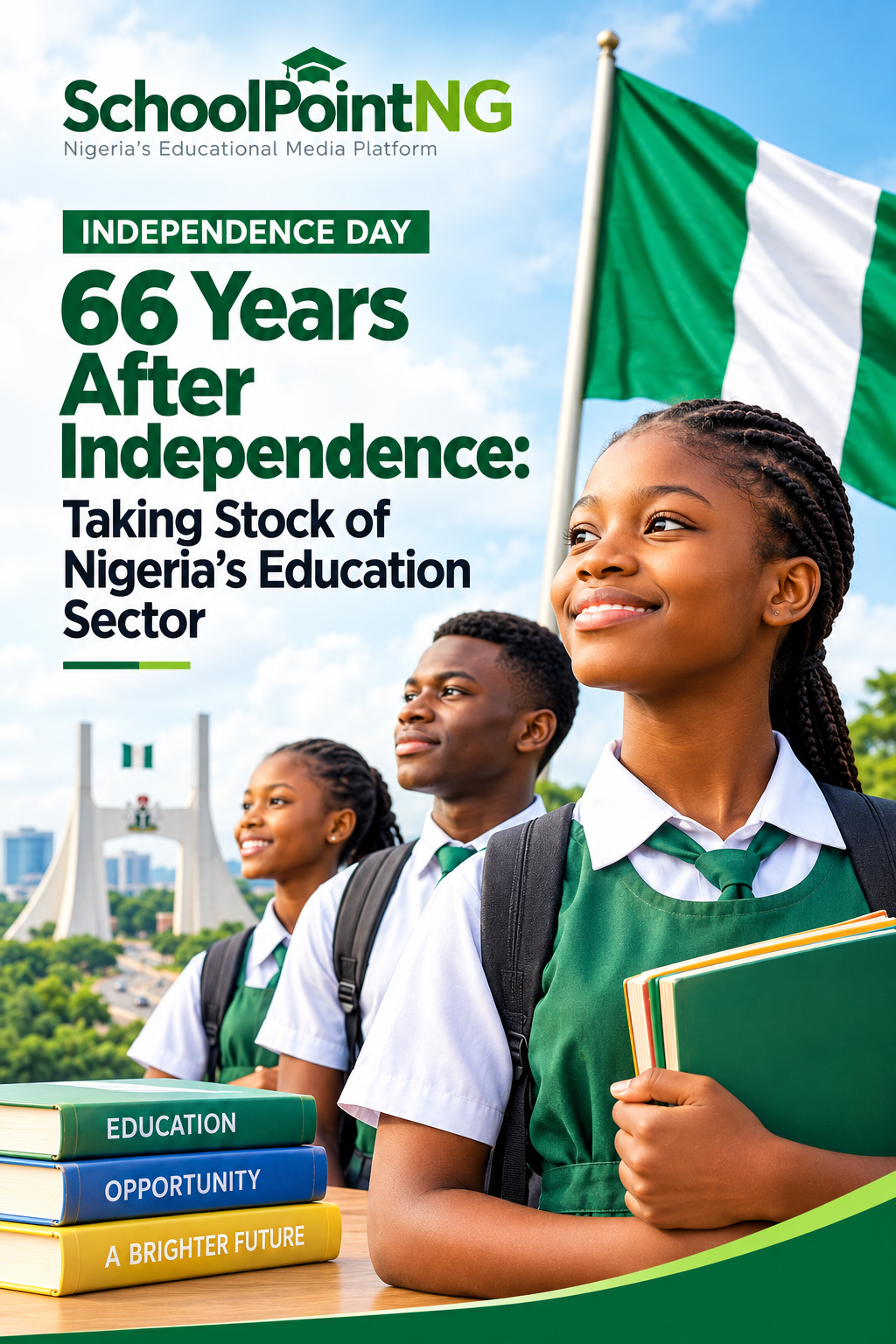
As Nigeria celebrates 66 years of independence, it is worth asking a question that goes beyond the colourful ceremonies, patriotic speeches and familiar promises: what has happened to the nation’s education system since 1960? The answer is neither an outright success nor a complete failure. Nigeria’s education sector has expanded dramatically over the decades, producing generations of professionals, academics, entrepreneurs, teachers, scientists and public servants. Yet, beneath the impressive growth in the number of schools and institutions lies a system still struggling with access, quality, funding, infrastructure and inequality.
At independence, Nigeria inherited an education system that was relatively small and unevenly distributed. Six and a half decades later, education has become far more accessible, with schools and tertiary institutions spread across the country and millions of Nigerian children and young people passing through the system every year. The expansion of universities, polytechnics, colleges of education and private schools has created opportunities that were unavailable to many Nigerians in the early years of independence. The growth of private education, in particular, has transformed the educational landscape, introducing competition, new teaching methods, technology and alternative models of school management.
But access alone cannot be the measure of educational progress. What happens inside the classroom matters just as much as getting children into school. Across the country, concerns remain about overcrowded classrooms, inadequate facilities, shortages of learning materials, teacher capacity and the quality of learning outcomes. In many communities, particularly those affected by poverty, insecurity and displacement, children continue to struggle to obtain uninterrupted education. The persistence increase in the number of out-of-school children also remains a reminder that Nigeria’s educational expansion has not benefited every child equally.
The condition of the teaching profession deserves equally serious attention. Teachers are the engine room of every education system, yet Nigerian educators have often had to work under difficult conditions. Questions around remuneration, welfare, professional development, workload and the availability of teaching resources continue to dominate conversations about education. It is difficult to build a world-class education system while treating the people responsible for delivering it as an afterthought. Nigeria must therefore move beyond celebrating teachers rhetorically and make sustained investment in their training, welfare and professional advancement a central component of education policy.
There is, however, another side to the story. Nigerian education is changing, and technology is opening doors that were unimaginable at independence. Online learning, digital classrooms, educational platforms, artificial intelligence and virtual tutoring are gradually changing how students access knowledge. Nigerian teachers and students are increasingly finding ways to use technology beyond the traditional classroom. But this transformation also exposes another national challenge: the digital divide. A student with a reliable internet connection, electricity and a personal device does not experience education in the same way as a student in a community without those basic facilities. Digital education will only fulfil its promise when access to technology becomes broader and more affordable.
At 66, therefore, Nigeria’s education story should be viewed as a work in progress. The country has built institutions, expanded access and produced remarkable human talent, but it has yet to fully convert its enormous youthful population into the educational advantage that it could be. The next chapter must focus not merely on how many children are enrolled, but on what they learn, the quality of their teachers, the relevance of their education and the opportunities available to them afterwards. Independence should remind us that the real strength of a nation is not measured only by its natural resources or physical infrastructure, but by the knowledge, character and capabilities of its people. If Nigeria is serious about securing its future, education cannot remain a promise for tomorrow; it must become a national priority today.